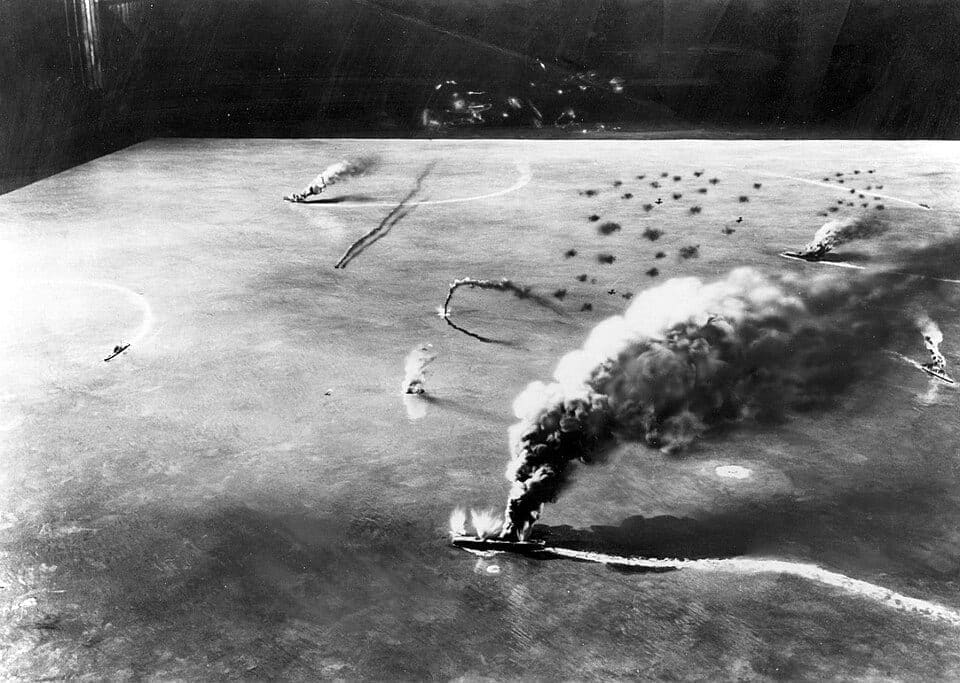
Six months after Pearl Harbor, Japan's navy ruled the Pacific and had not lost a battle. Then, in a few minutes over open ocean near a tiny atoll called Midway, four of its aircraft carriers went to the bottom, and the war in the Pacific turned for good.
The trap the Americans knew about
Admiral Yamamoto planned to lure the remaining American carriers into a decisive battle at Midway and finish them off. What he did not know was that American codebreakers had cracked enough of the Japanese naval code to read his plan. The Americans knew where and roughly when the blow would fall, and set an ambush of their own.
The carrier duel
Carriers fight at a distance, hurling aircraft at each other across miles of sea. On the morning of 4 June the two fleets groped for each other with scout planes and strikes. Wave after wave of American torpedo bombers attacked the Japanese carriers and were almost wiped out, seemingly for nothing.
The five minutes
Their sacrifice had pulled the Japanese fighters down to sea level. High above, American dive bombers arrived unopposed over three Japanese carriers caught at their most vulnerable, decks crowded with fuelled and armed aircraft. In roughly five minutes they turned three of them into blazing wrecks. A fourth was hunted down and sunk later that day.
The reckoning
Japan lost four fleet carriers and many of its best naval pilots in a single day, losses it could never fully replace. The United States lost one carrier, the Yorktown, and could build more.
The tide turns
Before Midway, Japan attacked where it pleased. After it, the initiative in the Pacific passed to the Americans and never came back. It is remembered as one of the most decisive naval battles in history, won by intelligence, courage, and a few minutes of perfect timing.