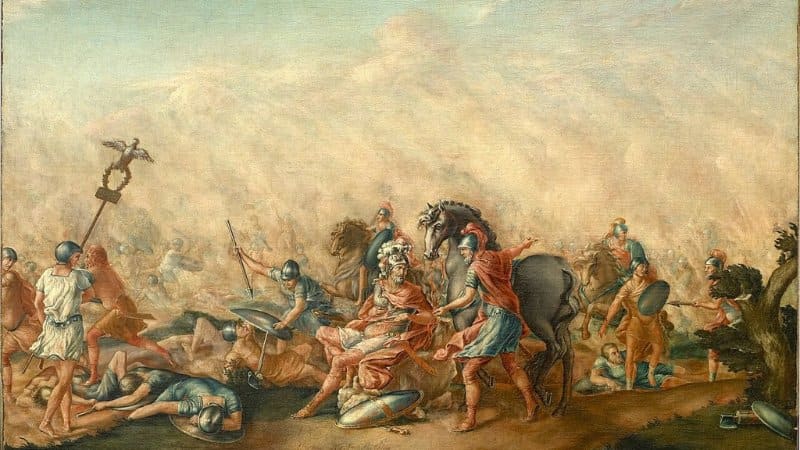
Most great victories are won by breaking the enemy's line. At Cannae, Hannibal won by inviting the Romans to break his, and then closing around them. It remains the classic example of a smaller army destroying a larger one, and 2,200 years later it is still taught as the ideal shape of a battle.
Two years of disaster
By the summer of 216 BC Hannibal Barca had been loose in Italy for two years, wrecking Roman armies at the Trebia and Lake Trasimene. Rome answered with the largest force it had ever fielded, around 80,000 infantry and 6,000 cavalry, commanded on alternating days by the consuls Lucius Aemilius Paullus and Gaius Terentius Varro. Against them Hannibal had perhaps 40,000 foot and 10,000 horse. On the flat plain by the Aufidus river, the Romans meant to use their weight to simply push through.
The crescent that bent, not broke
Hannibal shaped his line to fail on purpose. He pushed his least reliable troops, Gauls and Iberians, forward into a shallow crescent bulging toward the enemy, and held his hardened African veterans back on either flank. When the massed Roman infantry hit the centre, it gave ground slowly, the crescent flattening and then caving inward. To the Romans it looked like victory. They pressed deeper, packing tighter, into a pocket.
The cavalry closes the ring
The trap needed the wings. On the flanks, Hannibal's heavier and more numerous cavalry under Hasdrubal shattered the Roman horse, rode clean around the back of the field, and struck the legions from behind. At the same moment the African veterans, until now untouched, wheeled inward from both sides. The Roman army, still shoving forward at the centre, was suddenly surrounded on every face. Packed too tight to swing a sword or flee, it was destroyed where it stood.
The bloodiest day
Ancient sources put Roman dead at 50,000 to 70,000 in a single afternoon, among them the consul Paullus, dozens of senators and a former consul. It is one of the deadliest days in the history of warfare. And yet Cannae did not win the war: Rome refused every overture, wore Hannibal down over years, and finally beat him at Zama in 202 BC. What survived was the battle itself, the "Cannae model" of total encirclement that commanders from Schlieffen onward have chased ever since.