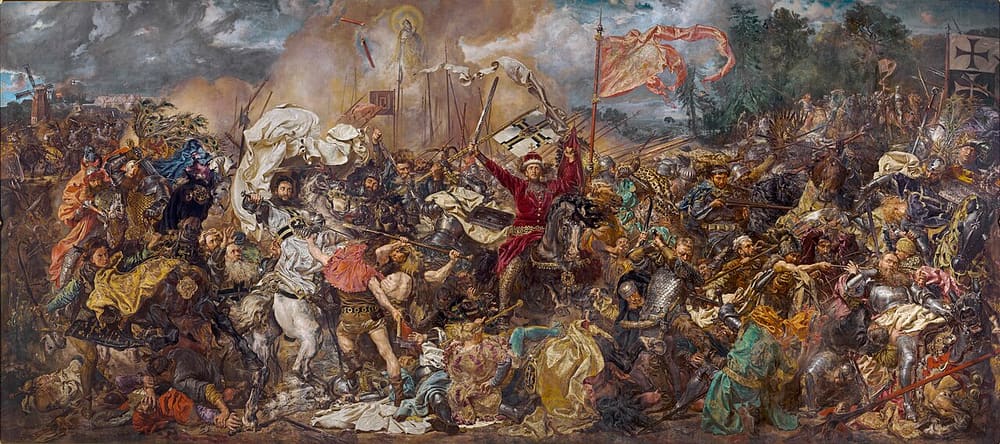
On 15 July 1410, on rolling fields between the villages of Grunwald and Tannenberg, one of the largest battles of medieval Europe destroyed the military power of the Teutonic Order in an afternoon. Known in Poland as Grunwald, in Lithuania as Žalgiris and in German as Tannenberg, it is the same day remembered under three names, and it still runs deep in the national memory of all three.
The Order and the alliance
For a century the Teutonic Knights, a crusading monastic order turned Baltic state, had expanded at the expense of their neighbours. Against them stood the union of the Crown of Poland and the Grand Duchy of Lithuania, sealed by the marriage that made the Lithuanian ruler Jogaila into King Władysław II Jagiełło of Poland. He and his cousin, Grand Duke Vytautas (Witold) of Lithuania, brought together a remarkable army: Polish knights, Lithuanian and Ruthenian riders, Tatar horse-archers and Czech mercenaries among them.
Two bare swords
The Grand Master, Ulrich von Jungingen, drew up his heavily armoured knights and waited. As the morning wore on and the allies did not attack, he sent Jagiełło a taunt, two naked swords, an invitation to fight if he dared. He would not live out the day.
The retreat that turned the field
The battle opened on the allied right, where Vytautas' lighter Lithuanian and Tatar cavalry engaged, then fell back. Whether a genuine rout or a deliberate feigned retreat in the steppe manner is still argued, but the effect was the same: it drew ranks of Teutonic knights out of formation in pursuit. On the left the Polish heavy cavalry ground forward in a long, brutal mêlée. When the Order committed its last reserves in a bid to reach and kill Jagiełło himself, the allied line held, enveloped them, and the Teutonic army came apart.
What the day decided
The Grand Master and much of the Order's leadership were killed on the field. The follow-up failed, the allies could not take the great fortress of Marienburg (Malbork), and the Peace of Thorn in 1411 was territorially modest. But the aura was gone. Grunwald broke the Teutonic Order's reputation and its offensive strength for good, and shifted the balance of power in the region toward Poland-Lithuania for generations. Few battles have meant so much to so many nations at once.