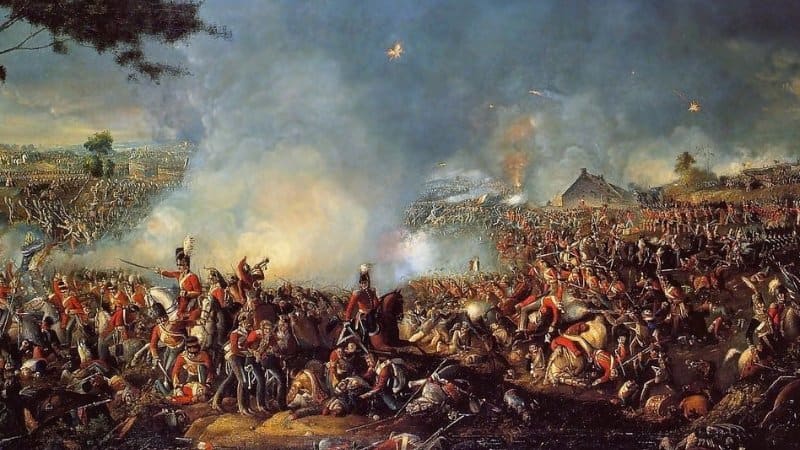
For twenty-three years the wars that carried Napoleon's name had rolled across Europe. On a single Sunday in the fields south of Brussels, they ended. Waterloo was not the largest battle of the age, nor the most elegant, but it was the most final: by nightfall an emperor was finished and a continent's map was set for a generation.
The Hundred Days
Exiled to the island of Elba in 1814, Napoleon slipped his guard, landed in France in March 1815, and marched on Paris gathering soldiers as he went. Within weeks he ruled again. The powers that had beaten him, Britain, Prussia, Austria and Russia, declared him an outlaw and began massing armies. Napoleon knew he could not fight them all at once, so he struck first into Belgium, hoping to smash the British and Prussian forces there before the others arrived.
The ridge at Mont-Saint-Jean
The Duke of Wellington chose his ground carefully: a low ridge near the village of Waterloo, where he could hide troops on the reverse slope and anchor his line on fortified farmhouses. Overnight rain turned the fields to mud, and Napoleon delayed his attack for hours to let the ground dry, hours that would cost him dearly. Wellington had a promise to lean on. The Prussian commander Gebhard von Blücher, beaten two days earlier at Ligny, had sworn to march to his aid.
Squares against cavalry
The French threw themselves at the ridge all day. The fortified farms of Hougoumont and La Haye Sainte became meat-grinders that swallowed thousands. In the afternoon Marshal Ney launched wave after wave of cavalry against Wellington's infantry, who formed hollow squares, a wall of bayonets on every side that horses will not charge. The squares held, bleeding but unbroken, as the horsemen broke around them like surf on rock.
Blücher keeps his word
Through the afternoon, dark columns appeared out of the woods to the east: the Prussians, arriving as promised. They fell on Napoleon's right flank at the village of Plancenoit, forcing him to peel off troops he could not spare. The battle Napoleon needed to win quickly was now a battle of two armies against one, and the clock had run out.
The Guard turns back
As a last throw, Napoleon sent forward his Imperial Guard, the veterans who had never been beaten. They climbed the ridge into concentrated musket and cannon fire and, for the first time, recoiled. When the cry went up that “La Garde recule”, the Guard is falling back, the French army lost its nerve and collapsed into rout. Wellington waved his hat and the whole line advanced.
The map that followed
Perhaps 50,000 men fell on that small stretch of ground. Napoleon abdicated for the last time and was shipped to Saint Helena, a rock in the South Atlantic, where he died in 1821. The victors redrew Europe at the Congress of Vienna and built an order that held off general war for decades. “Waterloo” entered a dozen languages as the word for the defeat you do not come back from.