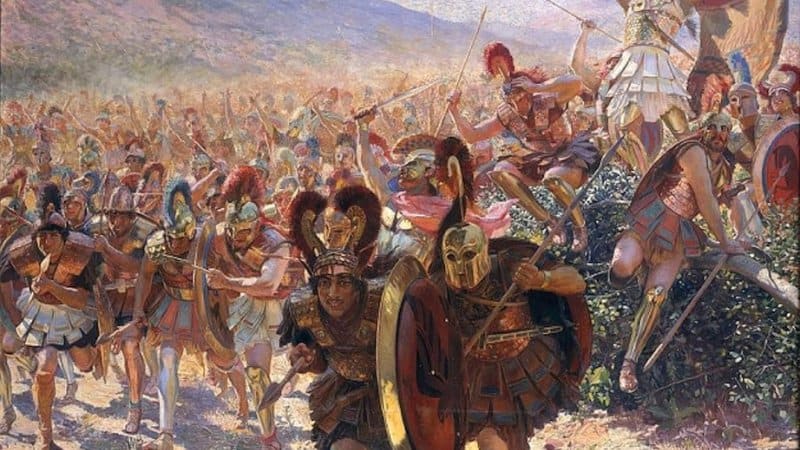
In the late summer of 490 BC, a few thousand citizen-soldiers of Athens stood on a plain by the sea and faced the largest empire the world had known. What happened on the beach at Marathon saved their city, and shaped the course of the West.
Persia comes
The Persian king Darius I had sent a fleet across the Aegean to punish Athens for supporting a revolt against him. The army landed at the bay of Marathon, north of the city, and there the Athenians, joined only by a small force from little Plataea, marched out to meet them. They were badly outnumbered, and Sparta, asked for help, replied that a religious festival kept it from marching until the moon was full.
The wait
For days the two armies watched each other across the plain. The Athenian generals were divided, until Miltiades, who knew the Persians, argued for attacking before the enemy cavalry could be brought into play. The decision fell to him.
The charge
Miltiades drew up his hoplites in an unusual line: thin in the centre, packed heavy on both wings. Then the Athenians did something the Persians had never seen, they advanced across the plain at a run, closing the distance under arrow fire to bring their long spears and heavy armour to bear before the archers could break them.
The double envelopment
In the centre the thin Greek line gave ground, as Miltiades meant it to. But on the wings the Athenians crushed the lighter Persian troops, then wheeled inward and fell on the enemy centre from both sides. The Persian army broke and ran for its ships, cut down as it fled across the marshes to the shore.
The numbers
By the count of the historian Herodotus, the Persians lost some 6,400 men; the Athenians, 192. It was the first time a Greek army had beaten the Persians in open battle, and it shattered the belief that they could not be beaten at all.
The run
Legend says a messenger ran the whole way to Athens with news of the victory, gasped it out, and died, the story behind the modern marathon. The truth is grander: the exhausted victors marched straight back to guard the city against the Persian fleet. Persia would return ten years later, to Thermopylae and Salamis, but Marathon had already proven it could be stopped.