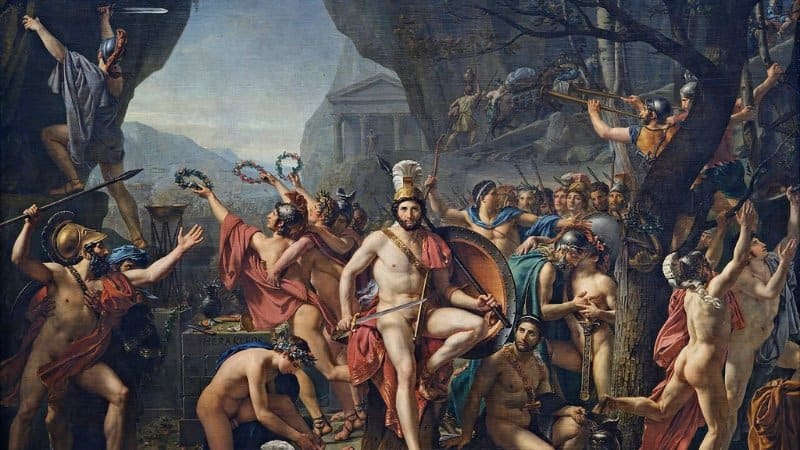
In the late summer of 480 BC, a small Greek force chose a stretch of coast barely wide enough for a cart and dared the largest army the ancient world had ever assembled to come through it. For three days it could not. Thermopylae is remembered for the way it ended, but the reason it still matters is how nearly it worked.
Why a narrow pass
King Xerxes I of Persia had crossed into Greece to finish what his father Darius had begun a decade earlier at Marathon. His army was vast, ancient writers claim millions; modern estimates land somewhere between 70,000 and 300,000, still overwhelming. Numbers like that are only an advantage where they can be brought to bear. The Greek plan, urged by the Spartans, was to deny them the space: hold the coastal defile at Thermopylae, the "Hot Gates," named for its sulphur springs, where the mountains pinch the road against the sea.
Roughly 7,000 Greeks gathered there under the Spartan king Leonidas I: his own 300 Spartiates, plus Thespians, Thebans, Arcadians, Corinthians and others. In the bottleneck, a Persian could only ever meet a Greek one or two at a time, and the heavily armoured hoplite, fighting shoulder to shoulder in the phalanx with his long spear, was built for exactly that.
Three days at the wall
For two days the Persians threw wave after wave into the pass and were cut down against the old Phocian wall the Greeks had rebuilt. Even Xerxes' elite Immortals, his ten thousand household guard, could make no headway. The Greeks rotated fresh men to the front and, by some accounts, feigned retreats to draw the Persians onto their spears. The battle was going, impossibly, in the defenders' favour.
The path over the mountain
It was betrayed, not beaten. A local named Ephialtes, hoping for reward, showed the Persians the Anopaia path, a track through the hills that came out behind the Greek position. Warned he was about to be surrounded, Leonidas dismissed most of the allied contingents to fight another day and stayed to cover their retreat with his 300 Spartans, the 700 Thespians who refused to leave, and the Thebans. They were enveloped and killed to the last man; Leonidas fell with them, and the Persians fought bitterly over his body.
A defeat that won a war
Thermopylae was a tactical loss. Its value was strategic and moral. The stand, fought alongside the naval action at Artemisium the same days, bought Greece time and proof that Persia could be resisted. Within months the Greek fleet destroyed Xerxes' navy at Salamis, and in 479 BC the army was broken at Plataea. The invasion failed. A stone at the pass carried the epitaph for the fallen: they lay there still, obedient to their laws.