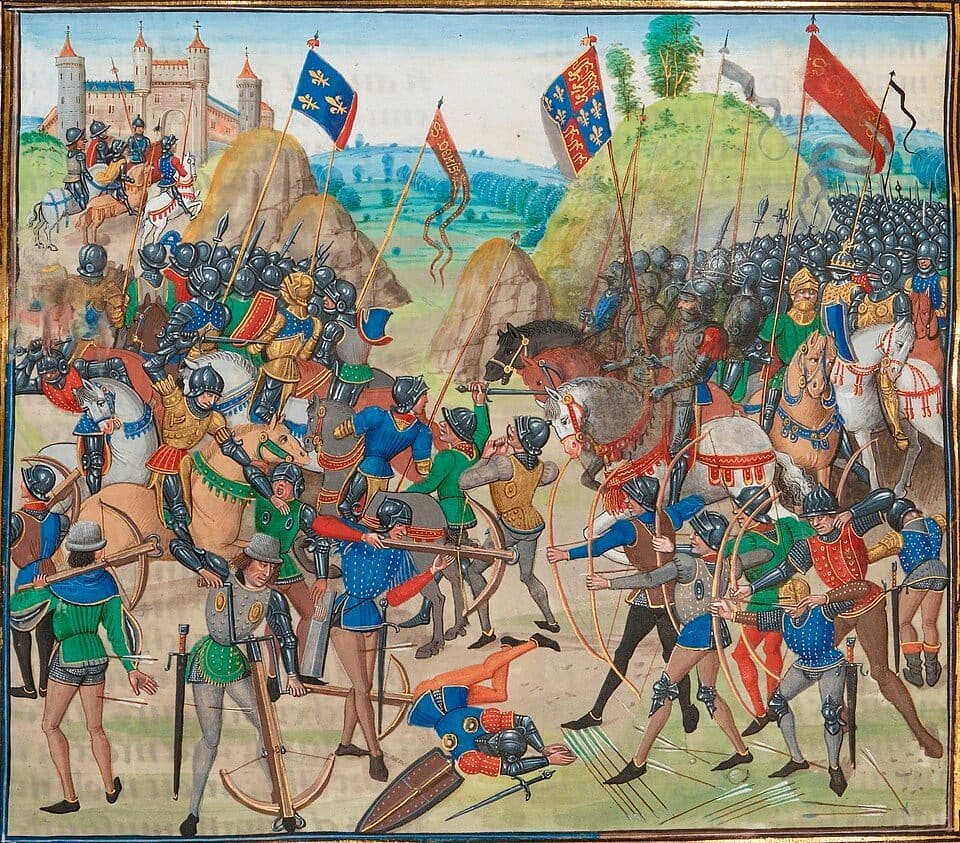
On 26 August 1346, near the village of Crécy in northern France, an outnumbered English army under Edward III destroyed the finest chivalry in Europe. It was one of the opening battles of the Hundred Years War, and it announced that massed archers could shatter the mounted knight who had ruled the battlefield for centuries.
The raid cornered
Edward had led a destructive raid across Normandy and was falling back toward Flanders when the far larger French army under King Philip VI caught up with him. Rather than run, Edward chose his ground on a gentle slope near Crécy and waited.
The longbow
He set his dismounted men-at-arms in the center with his longbowmen massed on the wings and protected by stakes and pits. When the French sent forward their hired Genoese crossbowmen, the longbows outranged them and swept them away before the real attack had even begun.
The arrows fell like snow, and the greatest chivalry in Europe died beneath them.
The charges
The French knights charged anyway, again and again through the day and into the night, riding over their own crossbowmen in their eagerness. Each wave rode into the arrow-storm and the stakes, and each broke in bloody confusion. Among the dead was the blind King John of Bohemia, who had asked to be led into the fight.
What the day decided
Crécy was a stunning victory against the odds and a turning point in the art of war. It carried Edward on to capture the port of Calais, which England would hold for two centuries, and it taught Europe a lesson in the power of the common bowman that would be repeated at Poitiers and, most famously, at Agincourt.
Frequently asked questions
When and between whom was the Battle of Crecy fought?
The Battle of Crecy was fought on 26 August 1346 near the village of Crecy in northern France, between the English army of Edward III and the far larger French army of King Philip VI. It was one of the opening battles of the Hundred Years War.
Why was the Battle of Crecy in 1346 a turning point in the art of war?
The Battle of Crecy in 1346 announced that massed archers could shatter the mounted knight who had ruled the battlefield for centuries. An outnumbered English army under Edward III destroyed the finest chivalry in Europe near the village of Crecy.
How did Edward III win the Battle of Crecy in 1346 despite being outnumbered?
At the Battle of Crecy in 1346 Edward III chose his ground on a gentle slope, set his dismounted men-at-arms in the center and massed his longbowmen on the wings behind stakes and pits. The longbows outranged the hired Genoese crossbowmen and swept them away before the main attack began.
Why did the French charges fail at the Battle of Crecy in 1346?
At the Battle of Crecy in 1346 the French knights charged again and again into the arrow-storm and the stakes, even riding over their own crossbowmen, and each wave broke in bloody confusion. Among the dead was the blind King John of Bohemia, who had asked to be led into the fight.
What were the consequences of the Battle of Crecy in 1346?
The victory at the Battle of Crecy in 1346 carried Edward III on to capture the port of Calais, which England would hold for two centuries. It also taught Europe a lesson in the power of the common bowman that would be repeated at Poitiers and Agincourt.
Who won the Battle of Crecy?
England under Edward III won the Battle of Crecy in 1346, when its outnumbered army destroyed the far larger French army of King Philip VI in one of the opening battles of the Hundred Years War.
Take the field at Crécy
Crécy is one of 40 battles in Echoes of Battle, told scene by scene, with a real-time tactical mode in the works, and pinned to the slope where the longbow ruled.