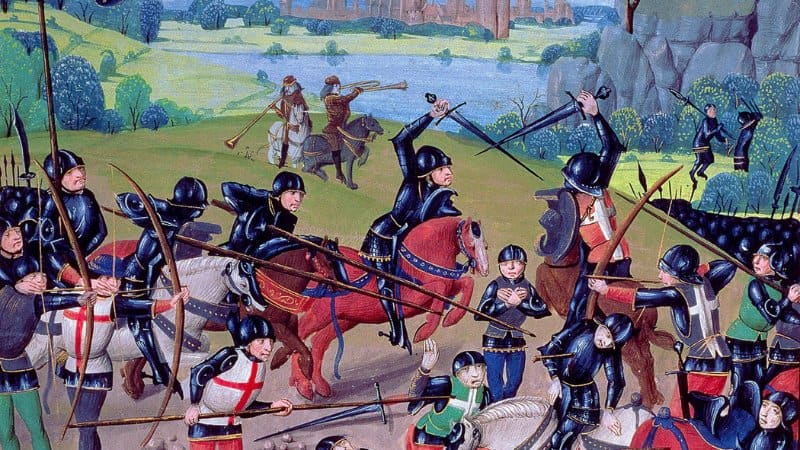
On a muddy field in northern France, a hungry, outnumbered English army fought the flower of French chivalry, and destroyed it. Agincourt is remembered as the day the longbow humbled the armoured knight, and as one of the most lopsided upsets in the history of war.
A march to disaster
King Henry V of England had landed in France and taken the port of Harfleur, but at a heavy price: a long siege and an outbreak of dysentery that hollowed out his army. Rather than sail home, he marched for the English-held town of Calais. A far larger French army moved to cut him off, and near the village of Agincourt, on 25 October, it finally did.
The field between the woods
The ground favoured the desperate. Henry drew up his men on a narrow, newly ploughed field, boxed in by thick woods on both sides. That funnel meant the French could not use their greater numbers to outflank him. Overnight rain had turned the freshly turned earth to deep, clinging mud.
The arrow storm
The heart of Henry's army was thousands of longbowmen, who planted sharpened stakes to break any charge and then loosed volley after volley into the packed French ranks. Under that iron rain the French men-at-arms advanced on foot, heads down, into the narrowing field.
The mud
The mud did the rest. Weighed down by heavy plate, funnelled together tighter and tighter, the first French line staggered forward exhausted and was cut down where it stumbled. Fresh ranks pushing from behind only piled into the crush. Lightly armoured English archers dropped their bows, took up mallets and knives, and waded in among the trapped knights.
The reckoning
French losses were catastrophic, thousands dead including a great swathe of the nobility, while English dead numbered only in the hundreds. At one tense moment, fearing a fresh attack on his rear, Henry ordered the killing of French prisoners, a decision debated ever since. By evening the field belonged to England.
Legend
Agincourt made Henry's reputation and, for a time, his claim to the French throne, sealed in the Treaty of Troyes. More lasting was the myth: the outnumbered band of brothers, the humble bowman felling the proud knight, a story Shakespeare would carve into English memory nearly two centuries later.