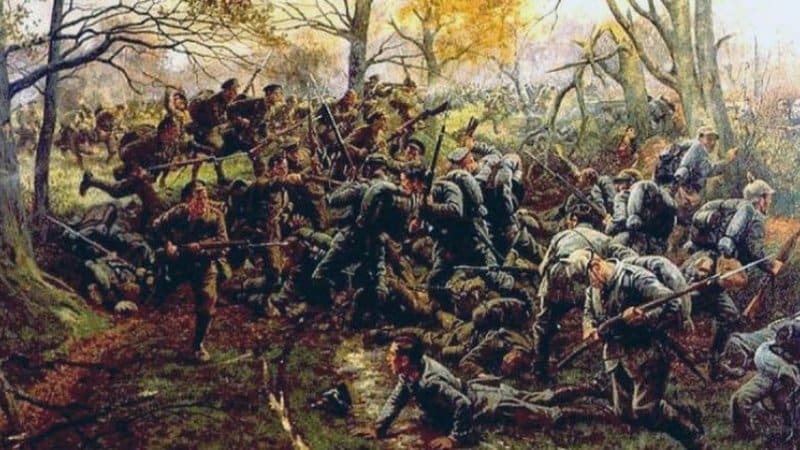
In October and November 1914, around the Flemish town of Ypres, the opening war of movement in the west came to its end. The First Battle of Ypres was the last time the armies could still try to outflank one another, and when it was over the front had frozen into a continuous line of trenches from the sea to Switzerland.
The race to the sea
After their retreat from the Marne, the Germans and the Allies each tried to work around the other's open northern flank, reaching ever closer to the Channel. The two sides finally collided in Flanders, and the last gap in the line was at Ypres.
The stand in Flanders
The Germans threw repeated attacks at Ypres, trying to break through to the Channel ports. British, French and Belgian troops held them off in weeks of desperate fighting. The cost fell heavily on Britain's small professional army, much of which was destroyed defending the town.
The last open flank closed at Ypres, and the war of movement was over.
The line sets hard
By late November both sides were exhausted and dug in for the winter. The salient bulging around Ypres, hard to defend and overlooked from the ridges, would be fought over again and again for the rest of the war.
What the day decided
First Ypres confirmed the deadlock that would define the Western Front for four years. The name itself became a byword for that front, and Ypres would return to history in 1915, when the first great gas attack was launched against its lines.
Frequently asked questions
Why did the First Battle of Ypres mark the end of the war of movement?
The First Battle of Ypres in 1914 was the last time the armies could still try to outflank one another in the west, and when it was over the front had frozen into a continuous line of trenches from the sea to Switzerland.
What was the race to the sea that led to First Ypres?
After the retreat from the Marne, in 1914 the Germans and the Allies each tried to work around the other's open northern flank toward the Channel, until they collided in Flanders where the last gap in the line was at Ypres.
Who paid the heaviest price at the First Battle of Ypres?
At the First Battle of Ypres in 1914 the cost fell heavily on Britain's small professional army, much of which was destroyed in weeks of desperate fighting to hold the town against repeated German attacks.
Why was the Ypres salient significant for the rest of the war?
After First Ypres in 1914 both sides dug in for the winter around a salient that bulged around the town, hard to defend and overlooked from the ridges, and it would be fought over again and again for the rest of the war.
What was the lasting significance of the First Battle of Ypres?
The First Battle of Ypres in 1914 confirmed the deadlock that defined the Western Front for four years, and Ypres returned to history in 1915 when the first great gas attack was launched against its lines.
Who won the First Battle of Ypres?
At the First Battle of Ypres in 1914 the British, French and Belgian defenders held the town and stopped the German attempt to break through to the Channel ports, so it counts as a defensive Allied success. The victory came at a heavy cost, with much of Britain's small professional army destroyed in the fighting.
Take the field at Ypres
Ypres is one of 40 battles in Echoes of Battle, told scene by scene, with a real-time tactical mode in the works, and pinned to the Flanders ground fought over for years.