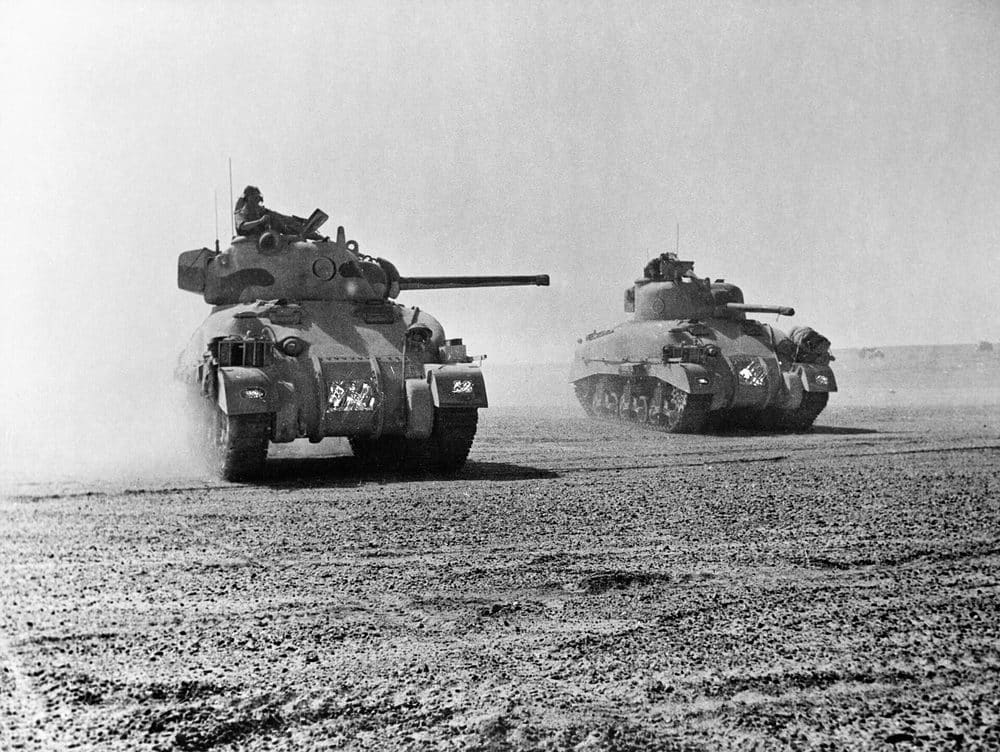
By the autumn of 1942 the Axis had driven deep into Egypt and stood barely sixty miles from Alexandria. Then, at a dusty rail halt called El Alamein, the British Eighth Army stopped Rommel and threw him back. Churchill called it the end of the beginning, and he was right.
Backs to the wall
After the fall of Tobruk the desert war looked lost for Britain. A new commander, Bernard Montgomery, took over the Eighth Army, steadied its nerve and refused to attack until he was ready. He built up a heavy advantage in men, guns and the new American Sherman tanks, and waited.
Operation Lightfoot
On the night of 23 October, nearly a thousand guns opened a bombardment that lit the horizon. Infantry cleared lanes through Rommel's vast minefields, the so-called Devil's Gardens, so the armour could pass. Montgomery called his method crumbling: grinding steadily through the Axis line rather than seeking one brilliant stroke.
Before Alamein, Britain had known only defeat. After it, the desert war ran one way.
The weight of steel
It became a battle of material and endurance. Allied code-breaking starved Rommel of the fuel and supplies crossing the Mediterranean, and his counterattacks withered for want of petrol. On 4 November the Axis line finally broke and the retreat began.
What the day decided
Rommel fell back some 1,500 miles across the desert. Days later the Allies landed in the west with Operation Torch, trapping the Axis in Africa between two fronts. El Alamein gave Britain its first clear land victory of the war and, with Stalingrad in the same weeks, marked the moment the Second World War began to turn.
Frequently asked questions
Why did Churchill call El Alamein in 1942 the end of the beginning?
El Alamein in 1942 gave Britain its first clear land victory of the war, stopping Rommel deep in Egypt and throwing him back. Coming in the same weeks as Stalingrad, it marked the moment the Second World War began to turn, which is why Churchill called it the end of the beginning.
What made Montgomery's approach at El Alamein in 1942 work?
At El Alamein in 1942 Bernard Montgomery steadied the Eighth Army and refused to attack until he had built a heavy advantage in men, guns and the new American Sherman tanks. He called his method crumbling, grinding steadily through the Axis line rather than seeking one brilliant stroke.
How important was supply and code-breaking at El Alamein in 1942?
El Alamein in 1942 became a battle of material and endurance. Allied code-breaking starved Rommel of the fuel and supplies crossing the Mediterranean, so his counterattacks withered for want of petrol until the Axis line finally broke on 4 November.
What were the strategic consequences of El Alamein in 1942?
After El Alamein in 1942 Rommel fell back some 1,500 miles across the desert. Days later the Allies landed in the west with Operation Torch, trapping the Axis in Africa between two fronts and turning the North African campaign one way for good.
When was the Battle of El Alamein fought and who took part?
The Battle of El Alamein was fought from 23 October to 11 November 1942 between the British Eighth Army and the Axis, at a dusty rail halt in Egypt after the Axis had driven to within about sixty miles of Alexandria.
Who won the Battle of El Alamein?
The Battle of El Alamein, fought from 23 October to 11 November 1942, was won by the British Eighth Army under Montgomery, which stopped Rommel and threw him back across the desert. It gave Britain its first clear land victory of the war.
Take command at El Alamein
El Alamein is one of 40 battles in Echoes of Battle, told scene by scene, with a real-time tactical mode in the works, and pinned to the real desert where the tide turned.