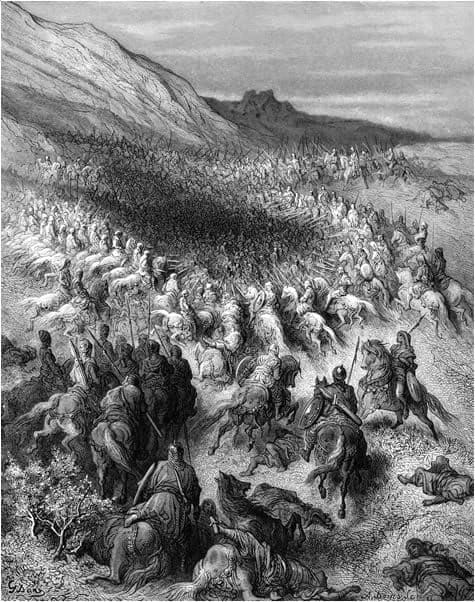
In the burning summer of 1187, an army of Crusader knights marched out across the dry hills of Galilee, banners drooping in the heat, throats already thickening with thirst. Ahead of them, blocking the way to water, waited the disciplined host of Saladin, sultan of Egypt and Syria. Within two days the finest fighting force the Christian states of the Holy Land could muster would be broken beneath two rocky hills known as the Horns of Hattin, and with it the Kingdom of Jerusalem itself.
A Kingdom Divided
By the 1180s the Crusader states clinging to the coast of the eastern Mediterranean were riven by rivalry. The throne of Jerusalem had passed to Guy of Lusignan, a king many of his own barons distrusted. Meanwhile Saladin had united the Muslim lands surrounding the kingdom under a single command, patiently building the strength to reverse the conquests of the First Crusade. A fragile truce was shattered when the notorious lord Raynald of Chatillon raided a caravan, giving Saladin both a cause and the opportunity he had long awaited. In the summer of 1187 he gathered a large army and crossed into the kingdom, laying siege to the town of Tiberias to lure the Christians into open battle.
The Fatal March
At the war council the Crusader leaders argued bitterly. Some urged caution, warning that to march across the waterless plateau in high summer was to invite disaster. But King Guy was persuaded to advance and relieve Tiberias. So the army set out, perhaps around twenty thousand strong including a core of heavily armored knights, straight into the arid country. Saladin's horsemen harried the column mercilessly, setting fire to the dry scrub so that smoke choked the marching men, and cutting them off from every spring and well. By nightfall the exhausted, parched Crusaders were forced to make camp on the high ground, with no water and the enemy all around them. Through the night, the sources tell us, prayers and the groans of thirsting men rose from the camp, while Saladin's confident warriors sang and fed their fires just beyond the Christian lines.
Thirst and Fire on the Horns
The next morning, tormented by thirst and blinded by smoke, the Crusaders tried to fight their way through to the Sea of Galilee. Saladin's army had them surrounded. The Christian infantry, desperate for water, broke away toward the twin peaks of the Horns of Hattin and could not be brought back into the fight. The knights charged again and again, but each time the encircling ranks parted and closed around them. One by one the great tents fell. The king's own red tent was toppled, and Guy of Lusignan was taken prisoner along with much of the surviving nobility. Most catastrophic of all, the relic the army carried before it into battle, the fragment of the True Cross, was captured, a loss felt as a spiritual disaster across Christendom.
The Road to Jerusalem
The victory at Hattin left the Kingdom of Jerusalem almost defenseless, its army destroyed in a single day. Saladin moved swiftly to gather the fruits of his triumph. City after city and castle after castle surrendered over the following weeks, many with scarcely a garrison left to hold them. Acre, Nablus, Jaffa and Ascalon fell in succession. In October 1187, only months after the battle, the holy city of Jerusalem itself surrendered to Saladin, ending nearly ninety years of Crusader rule. The shock of its loss echoed across Europe and helped launch the Third Crusade, which would bring King Richard the Lionheart east to face Saladin. Though the Crusaders later clawed back part of the coast, they never permanently recovered Jerusalem itself. The tide of that first Crusader age had turned, and it never fully returned.