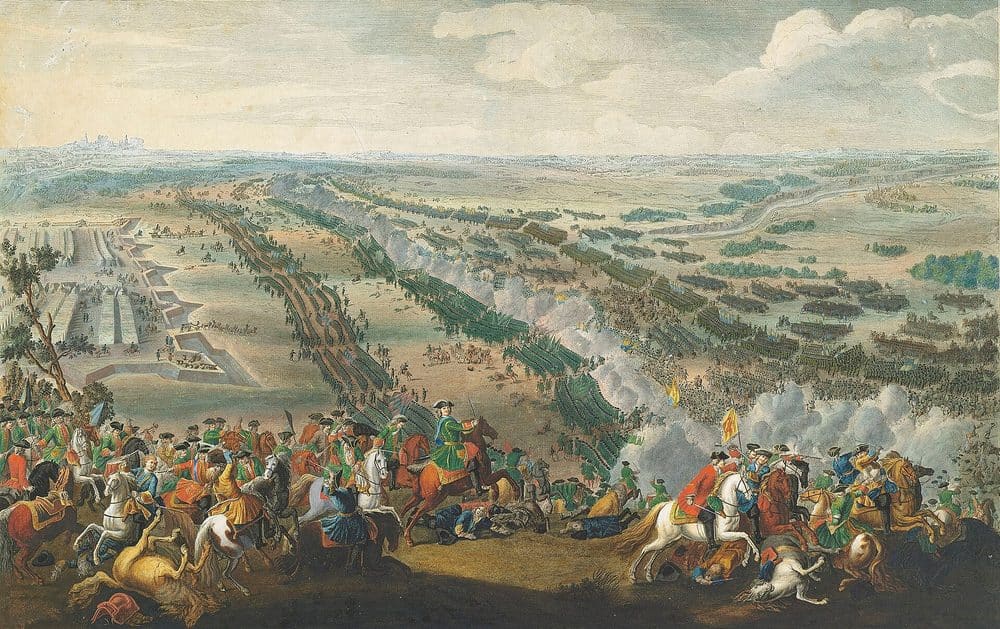
On a June morning in 1709, an exhausted Swedish army stumbled forward across the open steppe near the town of Poltava, deep in what is now Ukraine. For nine years King Charles XII had seemed unbeatable, marching from one victory to the next. Now, far from home, short of food, powder, and hope, his soldiers advanced into the guns of a Russian army their king had once written off. By nightfall the northern balance of power had shifted for good.
The road into Russia
The Great Northern War had begun in 1700 as a coalition against Sweden, and for years Charles XII scattered his enemies with astonishing speed, humbling Denmark, Poland, and Saxony in turn. Confident and restless, he turned east to finish Tsar Peter the Great for good. But Russia was vast, and Peter refused the pitched battle Charles craved, retreating and burning the land as he went. A brutal winter, one of the coldest in memory, wrecked the Swedish columns. Promised supplies and reinforcements were lost, and a hoped-for alliance with the Cossack hetman Mazepa brought far fewer men than expected. By the spring of 1709 Charles was besieging the fortress town of Poltava with a shrinking, hungry army, gambling that its fall would restore his fortunes.
A wounded king and a waiting tsar
Fate then dealt Charles a cruel blow. Scouting near the lines, he was shot through the foot, a serious wound that left him feverish and unable to sit a horse or lead in person. Command passed to Field Marshal Rehnskiold, while the king was carried on a litter. Across the field Peter had built a strong position anchored on a line of earthen redoubts, small fortified strongpoints that any Swedish attack would have to pass. The Russian army was larger, better fed, and far better supplied with artillery, the fruit of years of reform Peter had driven through his realm. The Swedes, by contrast, could count perhaps around twenty thousand fit men and were desperately low on gunpowder. It was a gamble born of necessity rather than confidence.
The assault breaks apart
At dawn on 27 June the Swedes advanced against the redoubts, and the plan unravelled almost at once. In the smoke and confusion the attacking columns lost cohesion, and a large portion of the infantry became separated and was later surrounded and forced to surrender. The survivors pressed on toward the main Russian line, hurling themselves forward in the fierce close assault that had won so many earlier fields. This time it was not enough. Massed Russian artillery and steady volleys tore great gaps in the thinning Swedish ranks, and Peter's counterattack rolled the exhausted attackers back. Within a few hours the famed Swedish army had broken. Thousands lay dead or wounded, and the shattered remnant streamed south in retreat.
The end of an empire
The retreat ended days later at the Dnieper river, where the trapped main body of the Swedish army, cut off and demoralized, surrendered en masse at Perevolochna. Charles XII escaped south into Ottoman territory with only a small escort, beginning years of restless exile. The scale of the disaster was staggering: an estimated several thousand Swedes killed and many thousands more captured, among them much of the officer corps. Poltava is remembered as one of history's decisive battles because it did more than lose a campaign. It broke the Swedish Empire as a great power and confirmed the arrival of Russia as the dominant force in the north, a shift that would echo through European politics for centuries.