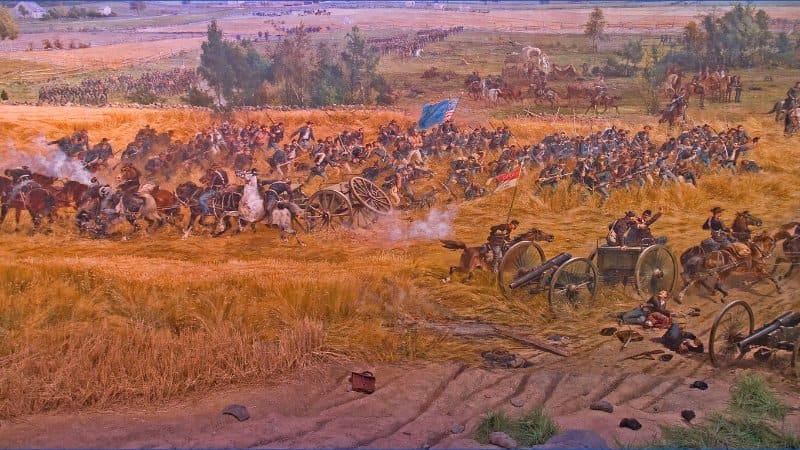
The industrial age remade war. Railroads moved whole armies overnight, the telegraph carried orders in minutes, and the rifled musket turned the old close-order charge into a death sentence. The American Civil War was where all of it came together, the first truly modern war, fought on a scale the world had never seen.
Fort Sumter, 1861. The thirty-four-hour bombardment that opened the Civil War, and, remarkably, killed no one.
Gettysburg, 1863. Three days, fifty thousand casualties, and the failed charge that marked the limit of the Confederacy.
The industrial age brought railroads, the telegraph, ironclads and the rifled musket to the battlefield. The American Civil War was its proving ground, the first truly modern war, where new technology met old tactics with terrible results.
Which industrial age battles does the guide cover?
This guide covers Fort Sumter in 1861, where the American Civil War began, and Gettysburg in 1863, the war's turning point and the high-water mark of the Confederacy.
Why was the American Civil War the first modern war?
Because it combined railroads, the telegraph, mass-produced rifled weapons and trench warfare on an industrial scale. Gettysburg alone saw around fifty thousand casualties in three days, a foretaste of the world wars to come.
Where did the American Civil War begin and where did it turn?
It began with the bombardment of Fort Sumter in 1861 and turned at Gettysburg in 1863, after which the Confederacy never again mounted a major offensive into the North.
Relive the battles
Echoes of Battle brings 40 of history's greatest battles to life, scene by scene, with a real-time tactical mode in the works. Join the list to be first when it launches.