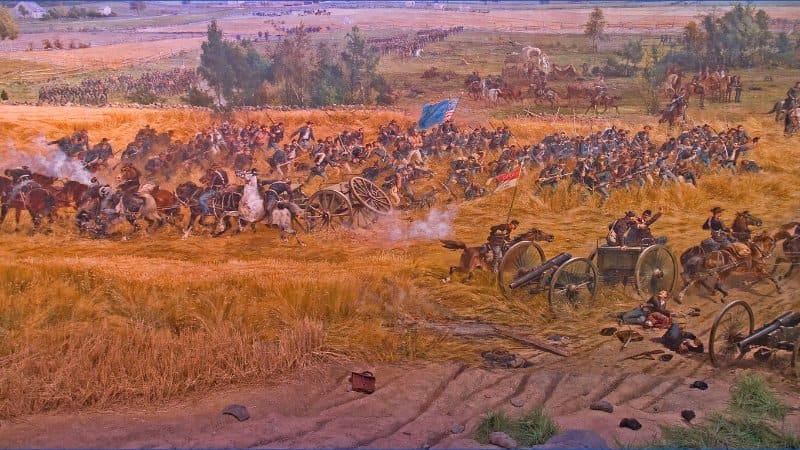
For three days in the summer of 1863, a small crossroads town in Pennsylvania held the fate of a divided nation. Gettysburg was the bloodiest battle ever fought in North America, and it broke the tide of the Confederacy's war. After it, the South never again mounted a serious invasion of the North.
Lee goes north
Fresh from victory at Chancellorsville, the Confederate general Robert E. Lee gambled everything on carrying the war into the North. A win on Union soil, he hoped, might shatter Northern morale and force a negotiated peace. His Army of Northern Virginia marched into Pennsylvania, with the Union Army of the Potomac, newly under General George Meade, hurrying to intercept it.
Day one: collision
The armies met almost by accident west of the town on 1 July. The Confederates drove the outnumbered Union troops back through the streets of Gettysburg, but the survivors rallied on the high ground to the south, on Cemetery Hill and along the ridges beyond. That high ground, shaped like a fishhook, would decide everything.
Day two: the flanks
On 2 July Lee hammered both ends of the Union line. The fighting at Little Round Top, the Wheatfield and the Peach Orchard was among the most desperate of the war. On the far left a Maine regiment, out of ammunition, held the hill with a bayonet charge. Battered and bent, the Union fishhook held.
Day three: Pickett's Charge
Convinced the Union centre must be weak, Lee sent roughly 12,500 men across three-quarters of a mile of open field straight at it. Pickett's Charge walked into a storm of cannon and rifle fire. A few hundred reached the stone wall at the crest, the “high-water mark” of the Confederacy, and were killed or captured there. More than half the attackers never came back.
The retreat
Lee pulled his shattered army back to Virginia through the rain. The three days had cost the two sides together some 50,000 casualties. Meade did not destroy Lee, and the war ground on for nearly two more years, but the Confederacy's best chance to win on the offensive had died on that ridge.
The Address
That November, at the dedication of the soldiers' cemetery, President Abraham Lincoln spoke for barely two minutes. In 272 words, the Gettysburg Address recast the war as a test of whether a nation “conceived in liberty” could endure, and gave the terrible battle a meaning that outlived everyone who fought it.