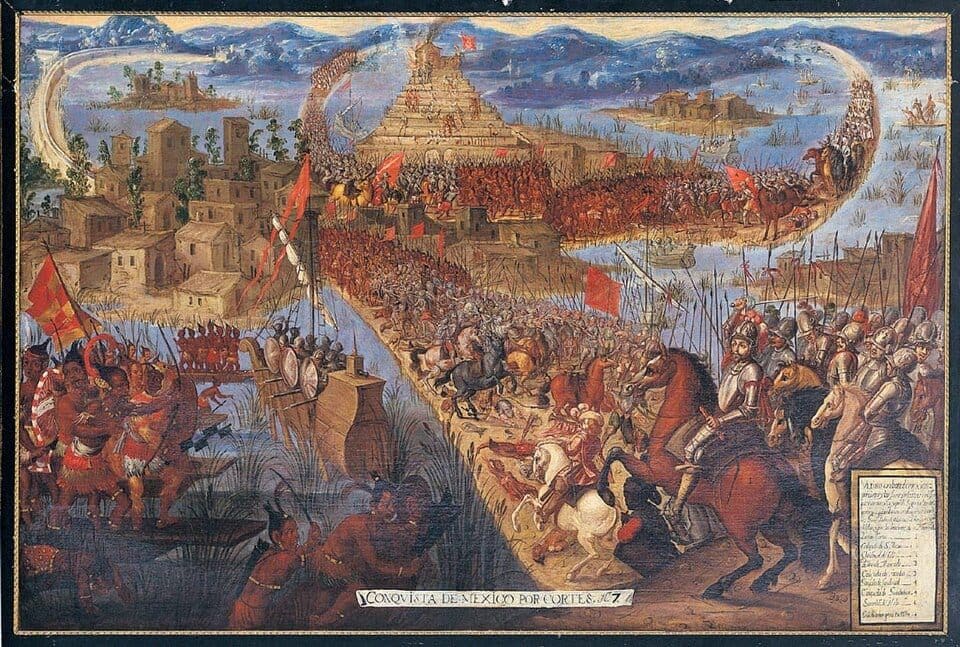
In the spring of 1521, one of the largest cities on earth stood on an island in the middle of a highland lake, its white towers reflected in the water. Within months Tenochtitlan, the dazzling heart of the Aztec world, would be starved, burned, and broken. The story is often told as a handful of Spaniards toppling an empire, yet the truth is larger and grimmer, a war fought mostly by Indigenous armies, decided by disease as much as by steel, and ending in one of the most devastating losses in the history of the Americas.
The City on the Lake
Founded in 1325 on an island in Lake Texcoco, Tenochtitlan had grown into a marvel of engineering, home to perhaps 200,000 people, linked to the mainland by great causeways and fed by canals, floating gardens, and an aqueduct of fresh water. When Hernan Cortes and a small Spanish force first arrived in 1519, they were stunned by its scale and order, comparing it to the enchanted cities of their own legends. The Mexica ruler Moctezuma II received them uneasily, and the Spaniards were welcomed into the city before the fragile peace collapsed into hostage-taking, bloodshed, and open revolt against the invaders.
La Noche Triste
By the summer of 1520 the Spanish position had crumbled. After a massacre at the great temple during a religious festival, the city rose in fury, and Moctezuma was dead. On the rainy night the Spaniards later called La Noche Triste, the Sad Night, Cortes tried to flee the city along a causeway under a storm of arrows and canoe-borne warriors. His force was shattered, losing an estimated several hundred Spaniards and many more of their Indigenous allies, along with much of the treasure they had seized. Cortes wept, the chroniclers say, but he did not give up. He withdrew to the lands of the Tlaxcalans, sworn enemies of the Mexica, and there he rebuilt his alliance and planned his return.
Disease and the Tightening Ring
While Cortes regrouped, an invisible ally did terrible work. Smallpox, carried unknowingly from the Old World, swept through the valley in an epidemic that killed a vast portion of the population, including the new ruler Cuitlahuac. The Mexica had no immunity and no defense, and the sickness gutted their leadership and their fighting strength at the worst possible moment. When Cortes advanced again in 1521, he came with tens of thousands of Indigenous allies and a fleet of small ships, built in pieces and carried overland, to seize control of the lake. He cut the aqueduct, blockaded the causeways, and slowly strangled the island. What followed was not a swift conquest but a grinding siege of around three months, fought street by street, canal by canal.
The Fall of an Empire
Through the summer of 1521 the defenders fought on with extraordinary courage, led now by the young ruler Cuauhtemoc, holding their crumbling city amid famine, thirst, and the stench of the dead. The attackers advanced by demolishing houses and filling canals, turning the city they had once admired into rubble as they went. By August the surviving Mexica were penned into a shrinking corner of the ruins. When Cuauhtemoc was captured trying to cross the lake, organized resistance ended. Tenochtitlan had fallen, and on its shattered island the Spanish would raise Mexico City. The human cost was staggering, with countless dead from war, hunger, and plague, and the destruction of one of the great civilizations of the world, a loss whose weight is still felt across Mexico today.