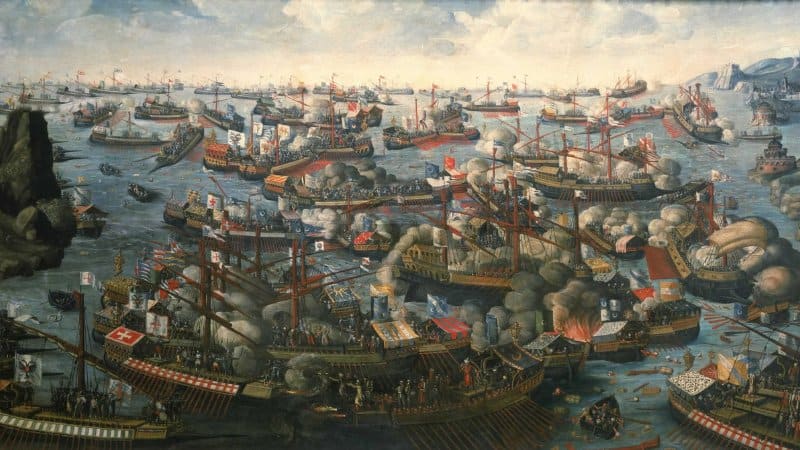
On 7 October 1571, in the Gulf of Patras off the coast of Greece, more than 400 galleys met in the largest oared-ship battle history has ever recorded. In a single afternoon the fleet of the Holy League broke the naval power of the Ottoman Empire and ended a century in which the sultan's ships had seemed unstoppable in the Mediterranean.
The Holy League
After the Ottomans seized Cyprus and butchered the defenders of Famagusta, Pope Pius V forged an alliance that Christian Europe had long failed to build: Spain, Venice, the Papal States, Genoa, Savoy and the Knights of Malta. Command went to Don John of Austria, the 24-year-old half-brother of the Spanish king, who welded rival captains into one fighting line.
Floating fortresses
The League's edge was firepower. Six Venetian galleasses, huge merchant galleys bristling with cannon, were towed in front of the fleet and tore great gaps in the Ottoman line before the main clash even began. Behind them, Spanish and Italian soldiers packed the decks with arquebuses, outshooting the Ottoman archers at close range.
Oar to oar
The battle became a storm of boarding actions, ship lashed to ship. In the center Don John drove straight at the Ottoman flagship; its commander, Ali Pasha, was killed and his great banner hauled down. On the wings the fighting swung both ways, but only the corsair Uluj Ali extracted a squadron and escaped. The rest was destruction.
What the day decided
Some 200 Ottoman ships were taken or sunk, tens of thousands of men were lost, and roughly 15,000 Christian galley-slaves were freed from the benches. The Ottomans rebuilt their fleet within a year, so the strategic map changed less than the legend suggests. But the spell was broken: the idea that the sultan could not be beaten at sea died at Lepanto. Among the wounded was a young Spanish soldier named Miguel de Cervantes, who lost the use of his left hand and called it a price worth paying.